


By Tema Hassan, Senior Product Manager at Zayo Europe.
Now that the European Peering Forum 2026 has concluded, I’ve spent some time reflecting on the sessions, discussions, and themes that emerged throughout the week. While every attendee will take away something different, a few strong messages consistently stood out to me.
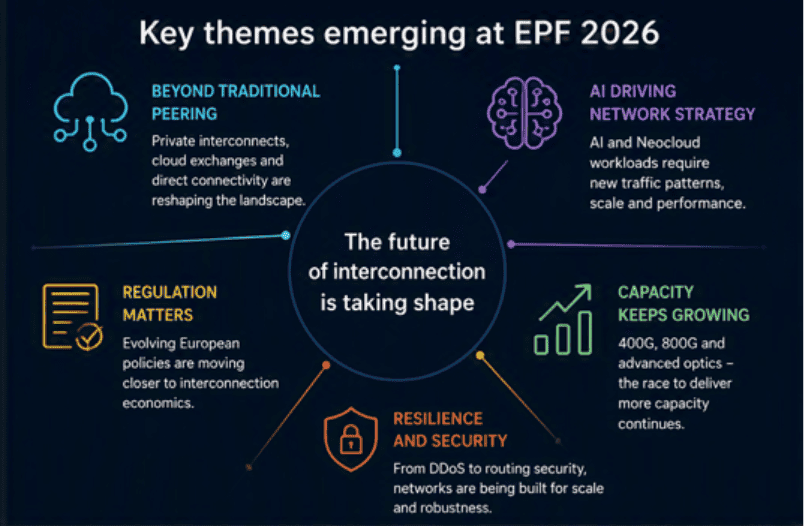
The industry is evolving beyond traditional peering
One of the most recurring themes was the evolution of Internet interconnection itself. Discussions around Internet Exchanges, private network interconnects (PNIs), cloud exchanges, and direct cloud connectivity highlighted an industry that is becoming increasingly interconnected rather than simply focused on peering.
The question is no longer “Where should I peer?” but rather “What is the optimal interconnection strategy across peering, private connectivity, cloud platforms, and application workloads?”
AI is rapidly reshaping network demand
The emergence of AI infrastructure providers and “Neocloud” operators was a major talking point throughout the event. Their requirements differ significantly from traditional content and CDN traffic patterns, creating demand for higher-capacity networks, lower latency, and increasingly sophisticated interconnection models.
As AI deployments continue to scale, the industry is clearly preparing for a future where network performance becomes an increasingly critical part of the AI value chain.
Capacity growth remains relentless
Whether discussing traffic engineering, optical innovation, or network architecture, the message was clear: demand continues to grow. Conversations have already progressed beyond widespread 400G deployment and are increasingly focused on 800G networking, advanced optical transport, and more intelligent utilisation of network resources.
Regulation is becoming a strategic consideration
Several sessions explored how European digital infrastructure policy and regulation may impact interconnection and network economics in the coming years. What was once largely viewed as a policy discussion is increasingly becoming a factor in commercial and network planning decisions.
Security and resilience are inseparable from growth
Network security, resilience, routing integrity, and DDoS protection featured prominently throughout the programme. As networks become larger and more interconnected, building resilient infrastructure is no longer optional; it is foundational.
In Summary
My biggest takeaway from EPF 2026 is that the industry is entering a new phase where connectivity alone is no longer enough.
The organisations that succeed over the next few years will be those that can bring together:
✅ IP Transit
✅ Cloud Connectivity
✅ Private Interconnection
✅ AI-Ready Infrastructure
✅ Automation and NaaS
✅ Security by Design
into a seamless customer experience.
What struck me most was how closely this aligns with the conversations many of us are already having with customers. Increasingly, they are not buying individual network services. They are looking for platforms that can simplify access to cloud, AI, applications, and global connectivity.
For me, EPF 2026 reinforced a simple but powerful message:
The future is not about building bigger networks. It’s about building smarter ecosystems of interconnection.
Talk to Tema: Learn More | Contact Us | Zayo